
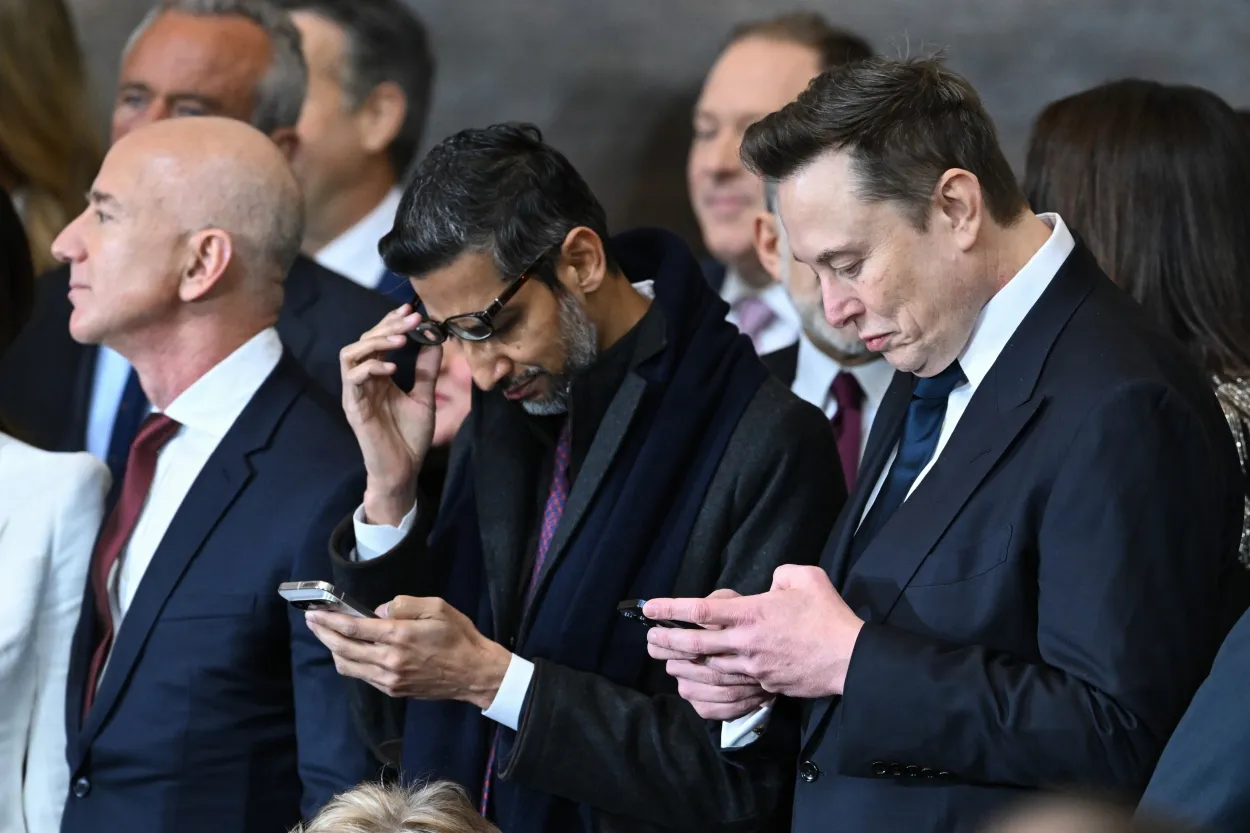
Have you ever wondered what the most materially wealthy people on the planet do? Where do these values come from, and who are they? Elon Musk is at this moment, they say, the richest person on the planet. As of 11 November 2021, his net worth was $299 billion according to the Bloomberg Billionaires Index methodology, and that amount consists of his holdings in Tesla, Inc., the world's most valuable car company, followed by SpaceX, Boring Co, Starlink and others.
How much is that?
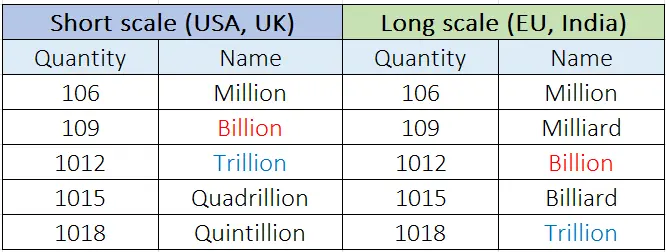
Before I continue, I'll briefly explain the order of the large numbers, because it's not the same in the world. The scale used in continental Europe, India, and elsewhere is called the long scale, while in the United States and more recently in the United Kingdom, the scale used is called the short scale. The scales are equal up to a million (10^6) and then they differ. The billions of dollars I mentioned above are European values (and I'll use them in the article), whereas the same value in the US is a trillion dollars, so keep that in mind in the future depending on the sources of information. Below is a comparison of the scales:
Who are the richest people?
The list of the 10 richest people consists of, in order: Elon Musk, Jeff Bezos (Amazon), Bernard Arnault (LVMH), Bill Gates (Microsoft), Larry Page and Sergey Brin (Alphabet i.e. Google), Mark Zuckerberg (Meta Platforms i.e. Facebook), Steve Ballmer (Microsoft), Larry Ellison (Oracle) and Warren Buffet (Berkshire Hathaway). I have listed the main companies of the mentioned people for easier understanding. For clarification, LVMH is an abbreviation for Louis Vuitton Moet Hennessy (a manufacturer of luxury goods), Oracle is an IT company known for its databases, and Berkshire Hathaway is an investment group whose owner has stated that he will donate most of his material wealth to the Bill and Melinda Gates Foundation until his death. Most of the others are familiar. This list highlights Elon Musk - not only is he at the top of the charts, but he's a media star, he has an "army" of followers who use social media and media to justify his every move no matter how contrary to common sense, and he's driving the global trend of electrification of cars. Over two-thirds of his fortune comes from his stake in Tesla, Inc. which is also the subject of this article.
I personally think that this list is not accurate for several reasons, one is that the values are manipulated which I will show you in the example of this article, and the other reason is that those lists are missing many people and for this purpose I recommend you to watch the excellent documentary „MONOPOLY: Who Owns the World?“ on the following link https://rumble.com/embed/vklfaf/?pub=4 or https://dokumentarac.hr/covid-19/film-monopoly-tko-je-vlasnik-svijeta/ .
What is Tesla, Inc?
It is an automobile and energy company headquartered in the United States, California. It was founded in 2003, and the following year, by investing in it, the largest individual owner became Elon Musk. It is engaged in the production of electric vehicles, energy storage battery systems, solar panels and chips and related services. Production of the first vehicle, the Tesla Roadster, began in 2009, followed by the Model S (2012), Model X SUV (2015), Model 3 (2017) and Model Y (2020). In 2020, they sold 499,550 vehicles, and in the first nine months of 2021, they sold 627,572 vehicles. The Model 3 is the first electric car to sell more than a million units (as of June 2021). In October 2021, the company's market capitalization exceeded $1 billion, making it the most valuable automotive company in the world. It employs over 70,000 people. Production takes place in four factories with two still under construction (4 in the USA, 1 in China and 1 in Germany). They've been publicly called out for creative accounting, labor rights violations, and unresolved technical problems with vehicles. And what is illogical about all of this, you ask?
Market value
Below is a list of the 10 most valuable car companies:
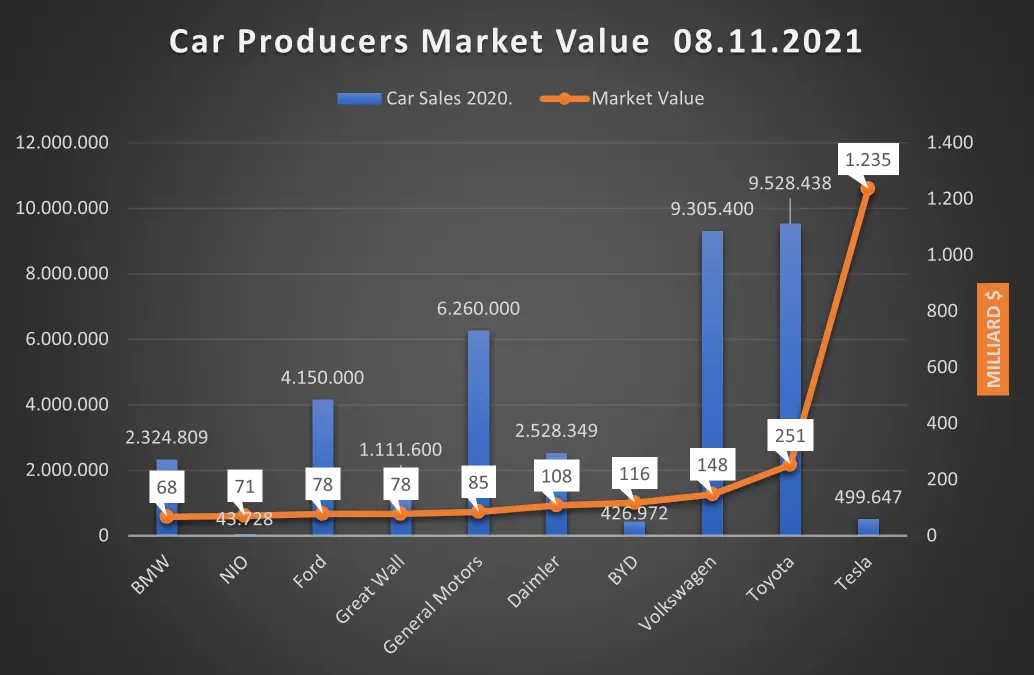
Among the top 10, Tesla's market value ($1.2 billion, Long scale) is greater than the value of all other nine combined ($1 billion cumulatively), while all others combined sold 35,679,296 vehicles in 2020 and Tesla sold 499,647 vehicles in 2020. That's 71 times more! In the first nine months of this year, Tesla sold 627,572 vehicles, but there's still a huge discrepancy between annual vehicle sales and market value. How is that even possible? To answer that, it's logical to ask further questions, like does Tesla have that much more assets than others? Not yet. Does it have any technology that others don't? No, Toyota, Volkswagen, Daimler, BYD and others already produce and sell fully electric vehicles, whereas NIO is a Chinese producer of exclusively electric vehicles. Mercedes is known as the greatest innovator in the automotive industry. Maybe electric vehicles have more value over time? They don't, and here's a quick explanation. According to research from the Wharton School of the University of Pennsylvania, USA, the cost of batteries for electric vehicles in 2020 is $144/kWh, and BloombergNEF predicts that by 2023, the cost will approach $100/kWh. Tesla vehicles have a capacity of 54-100 kWh and a warranty of 8 years or 160,000-240,000 km. They'll probably have to replace the battery after that. It means that you will either pay a hefty sum for new batteries or you will have a giant tablet in your backyard (this applies to all electric vehicles). Maybe Tesla's electric vehicles are "clean" and don't pollute the environment? Batteries use rare metals that are highly polluting, such as lithium, and we will still need gas, oil, coal, nuclear power plants, etc., to generate electricity. The problem of storing old batteries is not controversial theme in the public, yet. So there's no logical argument for why Tesla has such a high market value.
I will give you an example of one indicator of business success – net profit margin – the ratio of a company's net profit to its total revenue. In short, it is the percentage of revenue that remains with the company as net profit. For example, if our revenue is 100 kn and the net profit margin is 15%, this means that we have a net profit of 15 kn on the above revenue. A negative net profit margin means that the company cannot cover its costs from sales, i.e. from revenue.
Below is a summary of the average 5-year net profit margin as of 30.06.2020.:
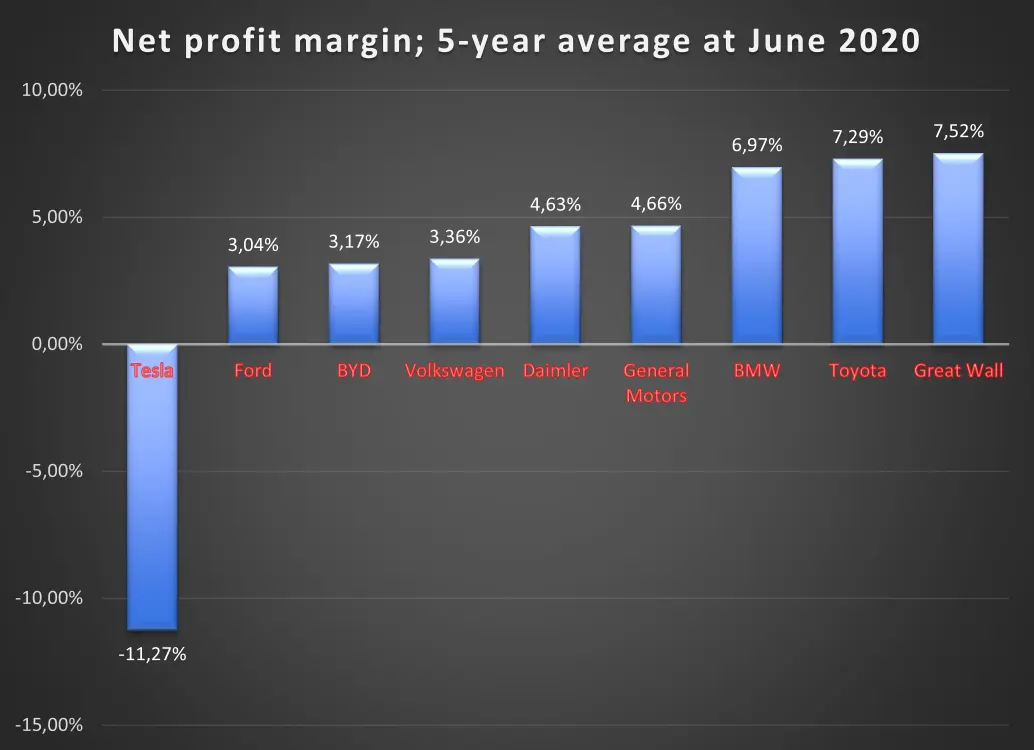
Tesla's net profit margin was 2.19% on December 31, 2020, and 7.40% on September 30, 2021, improving the average, which is still negative. How did they suddenly reach such positive values? More on that later.
Media manipulations
Tesla, Inc. and its largest individual owner Elon Musk are synonymous. He is a showman, a skilled salesman and a social media star with a large fan base who blindly listen to him, defend him and ignore the facts, which he skillfully uses, and which, together with the broken promises, which is his usual practice, has led to Tesla's astronomically unrealistic market value. Both have been the subject of various lawsuits due to the statements and business moves of their largest owner. There are enough examples to write a book, so I will show you some of the most important.
Since 2015, Tesla has been advertising the possibility of fully autonomous driving, which Musk then claimed would be possible in 2 years. The very next year, he claimed that all new Teslas have the technical capability of autonomous driving but that the software still needs to be adjusted. In 2019, he claimed that the option would be available in 2020. And so on. To this day, fully autonomous driving is not possible.
When Musk announced the electric car “for the masses”, the Model 3, he promised mass production, and a deposit had to be paid for the vehicles. Demand, as the media portrayed it, was huge. Potential buyers waited in lines to pay a deposit. Production was delayed due to technical difficulties and could not meet demand, so buyers waited for years for their vehicles. The whole situation was regularly covered by the media, and Elon Musk even slept in the factory to solve the aforementioned problems. Truth or marketing? Judge for yourself.
During this year, Tesla, speculating with Bitcoin, earned over $ 1 milliard in the growth of the value of Bitcoin, which is more than the profit from the sale of vehicles. When it was announced that vehicles would be able to be paid for in Bitcoin, the price of Bitcoin increased by almost 5%. Musk's tweets are known to cause major fluctuations in the value of Bitcoin and other cryptocurrencies that both Tesla and he trade, which is material for a serious investigation, but the US (and now the rest of the world) is known for not holding the powerful and wealthy accountable for such immoral moves. This is one of the reasons for the sharp increase in net profit margins this year.
And now the peak of manipulation - in early May 2020, with a series of tweets, in which he said he would sell almost all of his assets, he knocked down the value of Tesla shares by $ 14 milliard. The final tweet read "Freedom". Faithful admirers of his character and work explained this by saying that he was the embodiment of the American free spirit. And what about the shareholders whose investments he had destroyed? Apparently, he doesn't care. In October 2021, when the rental car company Hertz announced that they had ordered 100,000 Tesla vehicles, the value of the shares jumped by 13%, but immediately afterwards Musk crashed the value of the shares by 4% by announcing on Twitter that the contract had not been concluded. And finally, the tweet in early November this year. He asked his followers a survey question, with a promise to stick to the results of the survey, whether to sell his 10% of Tesla shares. 58% of the 3.5 million (!) survey participants answered positively, thus crashing the value of the shares again.
So he will do so because, well, his followers decided so, even though the reality is different. What is it about? In 2012, he received stock options, which are a compensation agreement between an employer and an employee that gives the employee (Musk was then officially the CEO of Tesla) the right to buy a certain number of shares at a certain price within a given time period. Elon Musk has stock options that expire in August 2022. According to them, he has the right to purchase 22.86 million shares at a price of $6.24 per share. The value of the shares before the survey question was $1.221,44. According to this, at that moment his capital gain in the shares would have been $28 milliard, which with a tax rate of 54.1% amounts to over $15 milliard in taxes. These are the reasons why he manipulates the value of the shares up and down, without caring at all about other investors.
Business practice
In 2016, as the majority shareholder of SolarCity (founded by his cousins), a solar panel manufacturer that was on the verge of bankruptcy, Musk decided to buy Tesla, integrate it, and save it. That would be fine if Tesla were his private company. However, since it is a public company, Tesla shareholders filed a lawsuit for $9.4 milliard, and the lawsuit is still ongoing.
Since 2018, over 30 top managers have left Tesla, including the CFO and almost the entire legal and finance department. Do you think top managers are leaving top companies? I leave that answer to you.
In 2013, Tesla received $1.3 milliard in tax breaks and incentives from the state of Nevada with a 20-year grace period, and the very next year, New York State awarded them $750 million in exchange for creating 5,000 “clean energy” jobs, which has not been achieved to date and the incentives have not been returned. In 2019, Tesla received a tax exemption in China in the amount of 10% on the price paid by customers.
Tesla earns more from selling regulatory credits than from selling vehicles and batteries. What is it about? In order to reduce the amount of carbon dioxide (CO2), governments around the world (EU and USA) have introduced incentives for manufacturers of electric vehicles and those whose vehicles emit low amounts of CO2. Those producers who do not meet the minimum parameters receive fines or can buy regulatory credits from other producers, who have a surplus, in order to avoid paying fines. As a manufacturer of exclusively electric vehicles, Tesla always has a surplus of regulatory credits that it sells to other manufacturers, and this is pure profit for them, there is no cost involved. This is the second reason for the sudden appearance of positive business indicators. The table below shows a comparison of net results and income from regulatory loans. Please note that the income from the sale of regulatory credits is included in the net operating result:
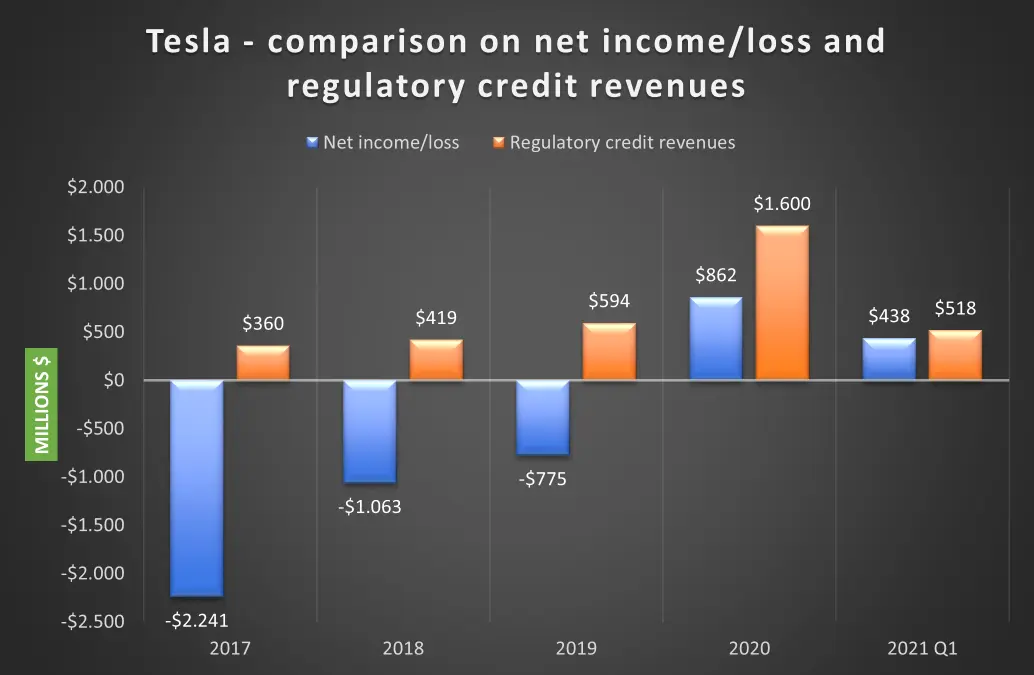
For example, the Stellantis group (formed by the merger of the French PSA and Fiat-Chrysler) is in the period 2019-2021. bought "green" loans from Tesla in the amount of $2,43 milliard. Credit Suisse forecasts that in 2021 Tesla's stated revenue will reach $2 milliard.
Conclusion
Tesla's market value (and Elon Musk's wealth) is anything but realistic. It is a huge bubble that could deflate, making many investors unhappy. And as British banker and analyst M. Feierstein said: "Tesla and Bitcoin are perfect partners - the first is an overblown, risky investment that will most likely end in tears, while the second is... equal". We can "thank" Elon Musk for the following - with the moves and statements he uses to inflate his material value and run business ventures, he opened our eyes and showed how this parallel world works. I am convinced that others do the same, in a slightly more subtle way. Every divorce, incoherent and illogical statements, various newspaper "news" are well-thought-out moves and have their own purpose. It is a well-known fact that in the USA the richest pay the least taxes - the federal tax code contains about 75,000 pages of regulations and only a few manage to navigate it.
Things are often not as they appear.